SCIENCE
CARICATURE
WHY CARICATURE WORKS - AND WHAT MAKES IT SO ELUSIVE
Likeness, through the lens of caricature, is a relative science, not an absolute one. When we look at a chair, for example, we interpret it in absolute terms: the chiseled back, the spindly legs, the light cherry wood and weathered seat cushion. It has no character, just a form. It’s a chair.
By contrast, when we look at a face, we reroute it to the fusiform gyrus, the brain’s resident authority of facial recognition, where we code likeness not in terms of how the face looks, but rather in terms of how it deviates from the mean. Anything bigger than the norm is a “big” nose, which we mentally project as even more massive and bulbous, and anything longer is a “long” philtrum, which in our perception we stretch out like an overused rubber band. Add to this standard deviation the degree to which personality manifests itself in a person’s features and expressions over time. The science of perception intersects with artistry profoundly here.
To best identify and remember people, we actually have evolved to remember them as caricatures.
That’s why it is often said the gauge of a good caricatured likeness is whether it's quicker to recognize the victim by their caricature than by their photograph. Their likeness is our visual exaggeration of their differences from the average, exactly how we remember them.
From the caricaturist's perspective, it is silly that we define facial beauty as perfectly proportioned, conforming to standards rather than introducing originalities. What makes the old man so much easier to caricaturize than the little girl is that his features exhibited what I call a much higher difference quotient, or degree of difference from average in each region of his face over the total. In contrast, the average face would have difference quotient of zero, void of caricaturable likeness, void of originality. It would also be impossible to remember. The difference quotient is a metaphorical concept, as it doesn’t yield actual values other than zero or the undefined value meaning the face is nonexistent, but it does offer a relative measure. After all, can’t you, without giving it too much thought, determine whose difference quotient is very high (those people who already look like caricatures of themselves) or very low (the ultra-average)? As a mathematical approximation for someone’s likeness, doesn't it figure that the closer we come to this ideal normal face, the less memorable we make ourselves? Our differences define us because they are all we are capable of remembering—not your “perfect” chin, eyes, and forehead; our fusiform gyrus doesn’t have space to care about irrelevant and common data like that.
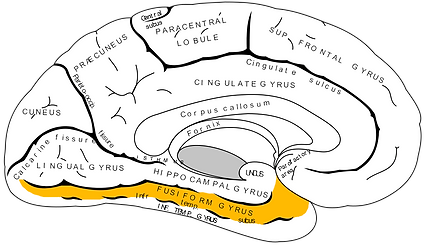
the fusiform gyrus, our brain's resident authority for facial recognition


why the boy with the low difference quotient makes a more challenging caricature than the man with the high difference quotient

This is a computer-generated approximation of the average male face. You can prove to yourself that the science checks out by looking at this face and then looking away—you won't be able to remember anything but the colors!
You can gauge how similar this face is to your brain's personal average based on how well you can remember his features. If you can only remember the colors and none of his actual features, it's pretty close.
LEARN ALL THIS AND MORE:
LIVE CARICATURE WORKSHOP
